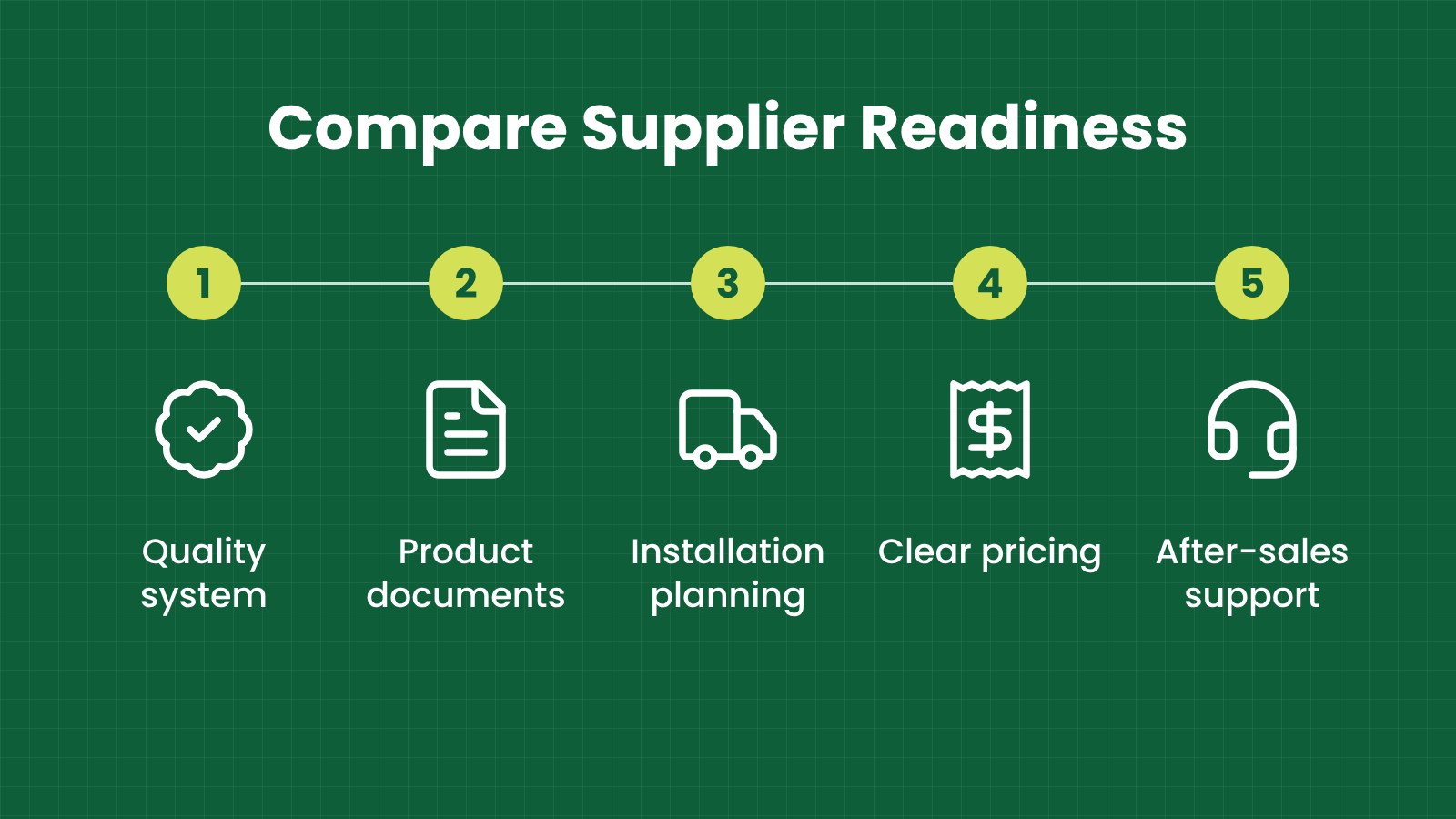
When you compare furniture suppliers, look at more than the quotation. Check whether the supplier can provide clear documents, suitable products, reliable installation and support after delivery.
Key Takeaways
- Set your requirements before asking suppliers to quote so you can compare like for like.
- Check quality and environment credentials, product information, warranty and after-sales support.
- Ask how delivery and installation will work at your site, including the safety arrangements for installation crews.
- Keep sustainability questionnaires and references relevant to your own supplier process; requirements can vary by buyer.
- iGreen holds ISO 9001, ISO 14001 and ISO 45001 certifications and supports office furniture projects in Kuala Lumpur and Penang, including at MNC factory sites.
The 2-minute version
- Set the brief: List products, quantities, locations, timing and installation needs.
- Check supplier basics: Review company information, certificates, warranty and relevant product documents.
- Compare the offer: Check what is included in the price and what would cost extra.
- Plan the site work: Confirm delivery access, installation timing, crew arrangements and who will coordinate.
- Check support after handover: Ask how to report a problem, obtain spare parts or request warranty service.
What do procurement teams usually compare?
Every buyer has its own process. Some use a short supplier questionnaire, while others request detailed documents or run a formal evaluation. There is no single checklist that applies to every MNC or project.
A clear comparison helps your team understand what each supplier is offering. Give suppliers the same product brief, site information and deadline. Ask them to identify assumptions, exclusions and alternatives so you can compare quotations fairly.
Start with the project itself: what furniture is needed, how many work areas are involved, where the furniture is going and when the space must be ready. For factory sites, share relevant access and delivery constraints early, such as booking procedures, security checks or restricted installation hours.
| Evaluation area |
What to check |
What a clear supplier response includes |
| Quality system |
Relevant quality management certification, such as ISO 9001 |
Current certificate details, scope and contact for questions |
| Environment |
Relevant environmental management certification, such as ISO 14001 |
Current certificate details and environmental information the buyer requests |
| Workplace safety |
Relevant safety management certification, such as ISO 45001, and site work arrangements |
Certificate details plus a practical explanation of how installation work is planned safely |
| Product quality |
Product specifications, available test reports, finish and intended use |
Documents that match the proposed product and model |
| Warranty and support |
Warranty period, coverage, exclusions, reporting process and spare parts |
Written terms and a clear after-sales contact |
| Delivery and installation |
Capacity, lead time, access needs, installation plan and handover |
A schedule, named coordinator and explanation of what is included |
| Commercial offer |
Product price, delivery, installation, optional items and exclusions |
A line-by-line quotation with assumptions and any additional charges stated |
| References |
Relevant project experience and permission to contact references |
Examples that relate to the project scope, shared with appropriate permission |
How should you check a supplier’s quality and environmental information?
Ask for the certificates or documents your company requires and check that they are current and relevant to the supplier and work being quoted. Look at the scope, certificate holder and expiry information. If your procurement procedure requires confirmation from the certification body or another source, follow that process.
ISO 9001 relates to quality management systems, ISO 14001 to environmental management systems and ISO 45001 to occupational health and safety management systems. These certifications can help a buyer understand how a supplier manages its systems. They do not by themselves prove that every product, delivery or installation will meet your project requirements.
Some buyers also send sustainability questionnaires, including EcoVadis-style assessments. These may ask about a supplier’s policies, practices and supporting documents. The questions and assessment process vary, so respond to the buyer’s actual request rather than assuming a particular questionnaire is required everywhere.
What product documents are useful?
Ask for documents that match the product models and quantities in the quotation. Depending on the furniture and project, these might include product specifications, assembly or care instructions, warranty terms and relevant test reports.
Check that a test report applies to the proposed model, configuration and intended use. If a report relates to a different size, material or product version, ask the supplier to explain the difference. Your technical team can decide whether the document meets the project’s requirements.
For chairs and workstations, you may also want information on available adjustments, finishes and spare parts. For storage or tables, check dimensions, configuration and any installation requirements. Ask suppliers to identify information they do not have rather than leaving the gap unclear.
How should you compare installation and delivery capability?
A product can be suitable on paper and still become a problem if delivery or installation is not planned around the site. Ask how the supplier will coordinate with your facilities contact, building management, security team or main contractor.
Confirm delivery dates, unloading arrangements, access routes, installation hours, packaging removal and the person responsible for site coordination. For factory or MNC sites, ask how the installation crew will receive site instructions and follow local access and safety procedures.
Check what happens if a delivery is delayed, an item arrives damaged or installation uncovers a site issue. A capable supplier should explain how changes will be communicated and how your team will be updated.
| Documents to ask a supplier for |
Why it helps |
What to confirm |
| Company profile and contact details |
Shows who is quoting and who will manage the project |
Legal entity, project contact and after-sales contact |
| ISO certificates, if requested |
Supports review of the supplier’s management systems |
Certificate holder, scope, validity and certification body |
| Product specifications |
Helps confirm the proposed item matches the brief |
Model, dimensions, materials, finish and configuration |
| Relevant test reports |
Provides technical information for buyer review |
Product or model covered, report date and issuing body |
| Warranty and care information |
Clarifies maintenance and support after delivery |
Coverage, exclusions, reporting method and spare-parts support |
| Delivery and installation plan |
Helps facilities teams plan site access and work |
Schedule, installation scope, crew coordination and packaging removal |
| Safety information for site work |
Helps coordinate installation with the site team |
Required documents, access instructions and escalation contact |
| Sustainability questionnaire or supporting documents |
Helps answer the buyer’s specific supplier questions |
Questionnaire version, requested evidence and response deadline |
| References or project examples |
Helps assess experience with similar work |
Comparable scope and permission to contact the reference |
How do you assess pricing transparency?
A low headline price may not include delivery, installation, access charges, assembly, packaging removal or after-sales support. Ask suppliers to separate these items so your team can understand the total cost and compare quotations on the same basis.
Check whether a quotation assumes standard access, normal working hours or a particular delivery location. If your site has special requirements, ask the supplier to price them clearly or list them as exclusions that still need confirmation.
If a supplier proposes an alternative product, ask for a separate price and a clear summary of how it differs from the original brief. This makes it easier for procurement and facilities teams to compare function, specification and cost together.
What should you look for in after-sales support?
Ask how your team should report a damaged item, missing part or warranty issue. Find out what information the supplier needs, who handles the case and how spare parts are requested.
Check whether the supplier can support the locations where the furniture will be used. For a project with more than one office, warehouse or factory site, confirm the service area and how follow-up visits will be arranged.
Ask what handover information will be provided after installation. Product care instructions, warranty details, contact information and a record of completed work can help your facilities team manage the furniture over time.
What common supplier evaluation mistakes should you avoid?
- Sending different briefs to different suppliers: Use one clear scope so quotations are easier to compare.
- Checking only the certificate logo: Review the certificate details and confirm that the scope is relevant.
- Accepting a test report without checking the model: Make sure the report relates to the product being offered.
- Comparing headline prices only: Check delivery, installation, exclusions and support.
- Leaving site requirements until the last minute: Share access, security and installation constraints early.
- Assuming every MNC uses the same ESG questionnaire: Follow the buyer’s specific supplier process.
- Requesting references without considering confidentiality: Ask suppliers to share examples with appropriate permission.
- Not naming an after-sales contact: Make sure your team knows where to go after handover.
Fictional Malaysian example: a factory office in Penang
This example is fictional and is for illustration only.
A Penang factory facilities team is sourcing workstations and chairs for an office expansion. It prepares one brief with product quantities, delivery locations, installation timing, site access steps and the documents needed for review.
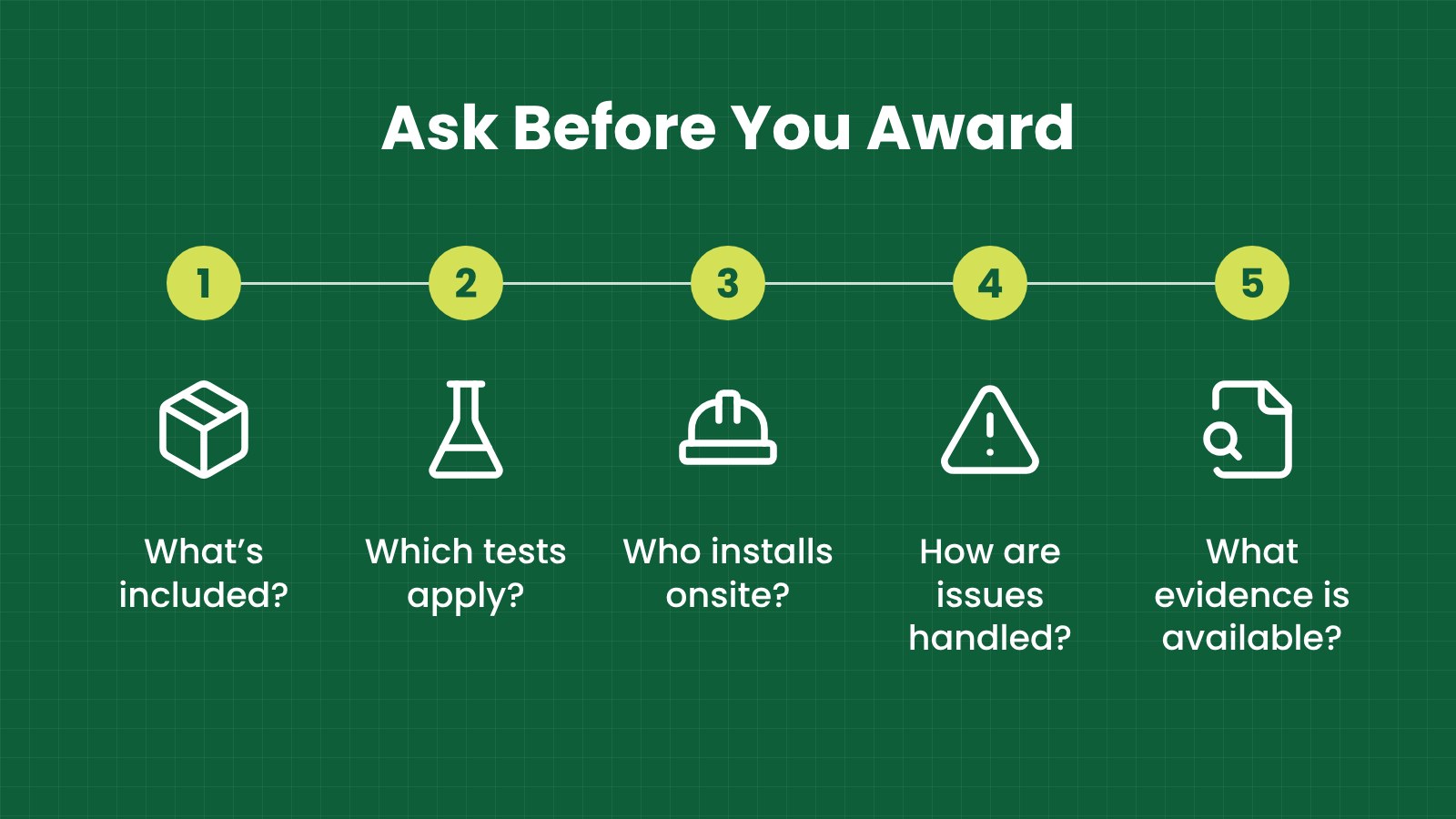
Three suppliers respond. The team checks certificate details, confirms that test reports match the models quoted and asks each supplier to separate furniture, delivery and installation costs. It also asks how installation crews will coordinate site entry and how warranty issues will be reported.
One supplier’s quotation excludes packaging removal and assumes standard access hours. The team clarifies these points before comparing final offers. The process gives procurement and facilities a clearer picture of each supplier’s proposal without assuming that any one document guarantees project success.
How is iGreen prepared to support your project?
iGreen holds ISO 9001, ISO 14001 and ISO 45001 certifications. We supply and install office furniture in Kuala Lumpur and Penang, including at MNC factory sites.
We can support the project from space planning and product selection through delivery and installation. Our team can help clarify the proposed furniture, site requirements, quantities, schedule and after-sales contact so your procurement and facilities teams have practical information to review.
Ask us for the documents relevant to your project and we will confirm what is available for the products and services being quoted.
Request a site assessment from iGreen (KL and Penang).
Frequently asked questions
What documents should I request from an office furniture supplier?
Start with the items relevant to your process: company details, requested ISO certificates, product specifications, applicable test reports, warranty information, delivery and installation plan, and any sustainability questionnaire documents.
Does an ISO certificate prove the furniture product has been tested?
No. ISO management system certifications relate to how an organisation manages a system. Product test reports are separate documents and should match the product model being quoted.
Should every supplier complete an EcoVadis assessment?
Not necessarily. Some buyers use EcoVadis-style sustainability questionnaires, while others have their own process or do not request one. Follow the requirements set by your organisation or customer.
Can iGreen support furniture delivery and installation at factory sites?
iGreen serves Kuala Lumpur and Penang, including MNC factory sites. Share your site access and installation requirements so the team can discuss the project arrangements.
Reviewed by
Official sources