This article is general guidance, not legal advice.
A safe’s fire rating and burglary rating describe different kinds of protection. A fire rating relates to tested performance when exposed to fire, while a burglary rating relates to resistance against specified attempts to break in; neither should be treated as a single all-purpose security score.
Key Takeaways
- Decide what you want to protect before comparing safes: documents, cash, valuables, data media or a mix.
- Fire and burglary ratings address separate risks, so check each one separately.
- Ask for documentation for the exact safe model, not a general brochure for a product range.
- Check the safe’s size, weight, installation location, access method and service support.
- Confirm any insurer, building or business requirements directly with the relevant party.
The 2-minute version
- List the contents: identify what needs protection and who needs access.
- Define the risk: decide whether fire, unauthorised access or both are the main concern.
- Check the evidence: ask for the model’s rating and test or certification documents.
- Plan the location: check dimensions, floor suitability, access and installation arrangements.
- Confirm the details: review locking, warranty, service and any insurer or building requirements.
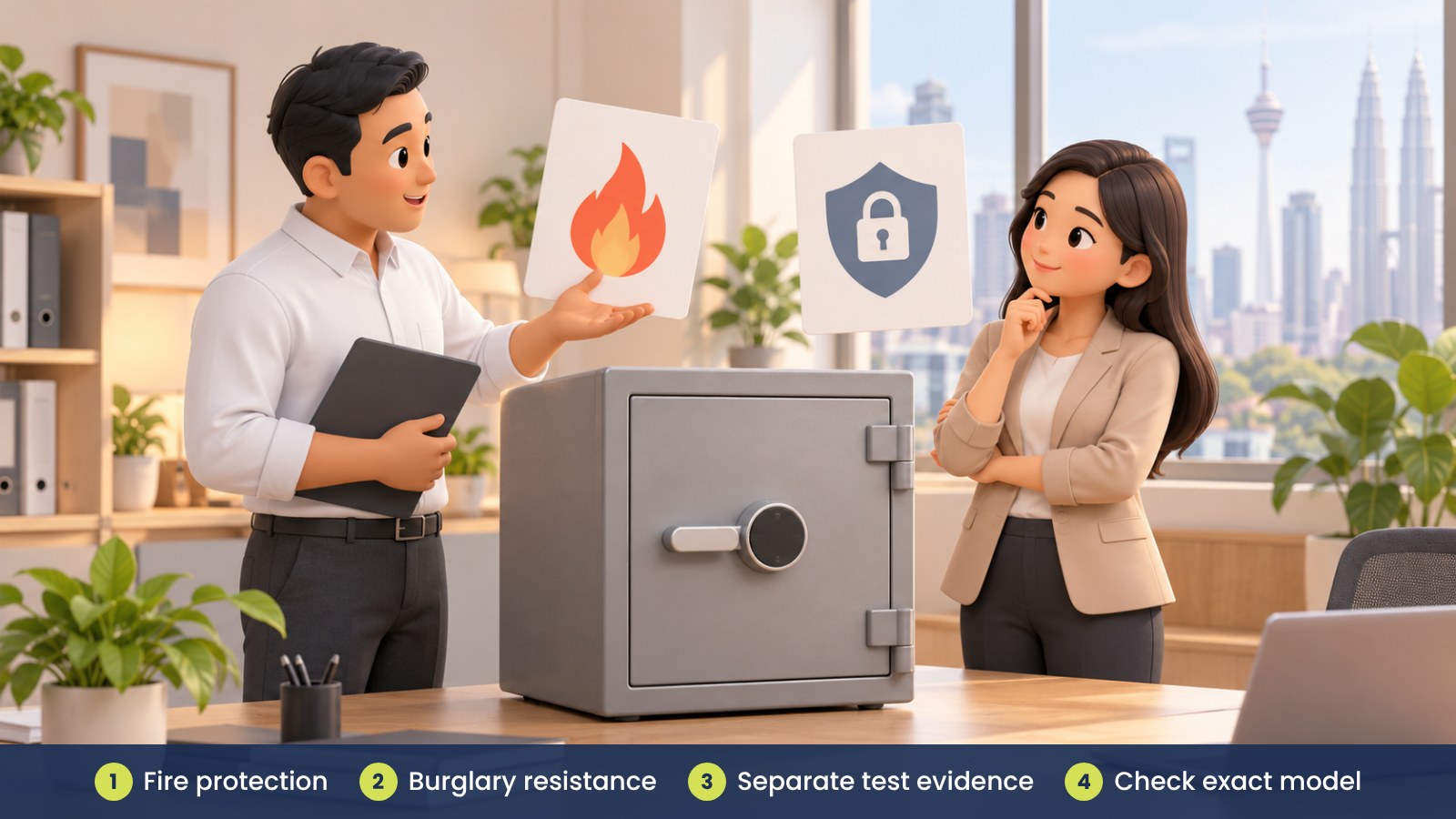
What is the difference between a fire rating and a burglary rating?
A fire rating concerns how a safe performs during a specified fire test. A burglary rating concerns how the safe resists specified attack methods. Because these are different tests for different risks, a safe’s fire performance does not tell you its burglary resistance, and vice versa.
UL Standards & Engagement lists UL 72 for record protection equipment. UL Solutions lists UL 687 as a standard for burglary-resistant safes. These standard names can help buyers understand the type of evidence being discussed; they do not mean that any particular safe model has been tested or certified to them.
European references buyers may also encounter include EN 1143-1 for graded burglary resistance, EN 1047-1 for fire-resistant data cabinets and inserts, and EN 15659 for light fire storage units. Ask for the certificate for the exact model and check that it suits the items you plan to store.
What does a fire rating tell a buyer?
It tells you that the manufacturer is describing performance against a particular fire-related test or classification. Ask what the safe is intended to protect, which test or standard is referenced and what documentation supports the claim.
UL 72 covers testing of record protection equipment during exposure to fire. The standard’s scope says that these tests are intended to demonstrate performance during fire exposure and are not intended to determine acceptability for use after fire exposure. So ask the supplier to explain what the documentation does and does not cover.
Do not assume every safe marked “fire resistant” has the same test basis, protection level or suitability for every kind of item. If you need to protect digital media or specialised records, tell the supplier what you intend to store and ask whether the model’s documentation addresses that use.
What does a burglary rating tell a buyer?
A burglary rating relates to a safe’s resistance to defined attempts at unauthorised entry. UL 687 is specifically titled “Burglary-Resistant Safes.” UL’s published scope describes categories involving attacks on the door and front face, and attacks on the door and body.
For a buyer, the practical question is not just whether a safe is described as secure. Ask what test or classification applies to the exact model, what parts of the safe were covered and which organisation issued the supporting documentation.
Do not assume that a lock specification alone describes the burglary resistance of the whole safe. Ask the supplier to explain the evidence for the safe as a complete product.
| Rating type |
Plain-language meaning |
What to ask the supplier |
| Fire performance |
Describes how the safe performed in a specified fire-related test |
Which test or standard applies, what contents is it intended for, and where is the report? |
| Burglary resistance |
Describes resistance to specified attempts to break into the safe |
What classification applies to this model, what attack scope is covered, and who tested it? |
| European standards |
May describe graded burglary resistance or fire testing for specific storage types |
Does the exact model have a certificate, and what products and contents does it cover? |
| Lock or access feature |
Describes how users open and manage access to the safe |
What access options are available, and what happens if keys or codes are lost? |
| Installation |
Describes how the safe is placed and secured at your site |
What floor, access and anchoring requirements should we review? |
How should you choose a safe for your business?
Start with the contents and the people who need access. A safe for a small set of documents may have different size and access needs from one used for cash, keys or other valuables. Consider how often staff need to open it and whether access should be shared or controlled by a small number of people.
Then consider the risks you want to address. Some businesses may prioritise fire protection for records; others may be more concerned about unauthorised access. If both matter, compare fire and burglary documentation separately rather than looking for one rating to answer both questions.
If insurance requirements matter, ask your insurer what evidence or safe classification it requires. Do not assume that a particular label will meet an insurer’s requirements without checking directly.
| Buyer check |
Questions to consider |
Why it matters |
| Contents |
What will be stored, and how much space is needed? |
Helps choose a suitable interior and capacity. |
| Access |
Who needs to open the safe, and how often? |
Helps compare locking and access arrangements. |
| Fire evidence |
What test or rating is documented for this model? |
Clarifies the basis and scope of a fire claim. |
| Burglary evidence |
What classification and test evidence apply? |
Clarifies the basis and scope of a burglary claim. |
| Site and installation |
Will the safe fit the location and delivery route? |
Helps plan placement, access and installation. |
| Support |
What warranty, service and access support are available? |
Helps you understand ownership after purchase. |
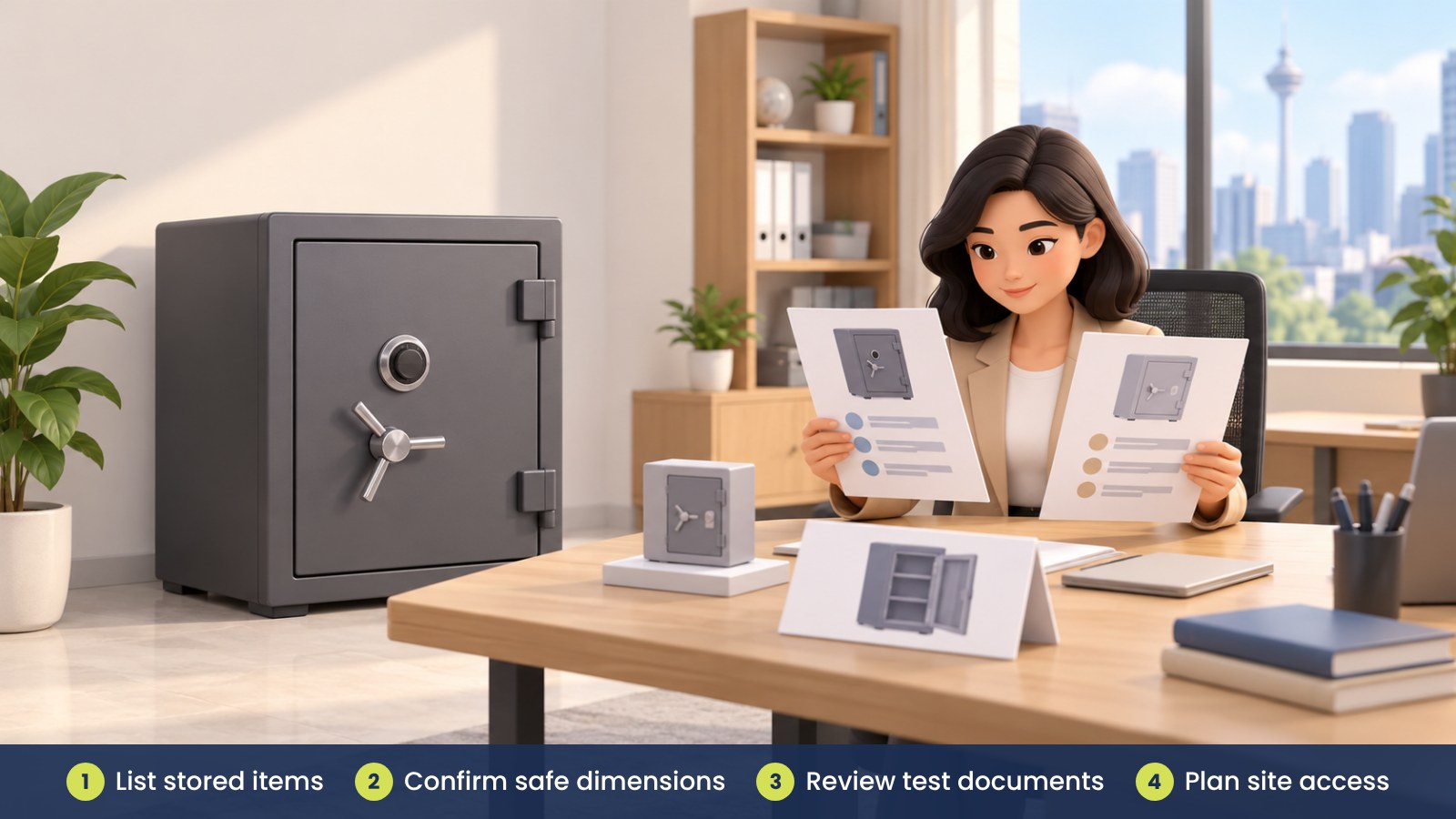
What documents should you request before buying?
Ask the supplier for documentation that identifies the exact model and clearly states the test or rating being claimed. Check that the document refers to the safe you are considering rather than a similar-looking model or a product family.
Request the test report, certification information or other supporting evidence that is available. Note the issuing organisation and check whether the document is current and relevant to your intended use. If the supplier cannot provide the document or explain what it covers, treat the claim as something to clarify before making a decision.
Also request the product dimensions, weight, installation requirements, warranty terms, user instructions and service contact details. These details help you plan the safe’s location and day-to-day use.
Where should you place a safe?
Check the safe’s external dimensions and weight before selecting a location. Discuss the proposed position and installation with your building or facilities team, particularly if you are unsure about the floor, access route or anchoring requirements.
Plan how the safe will reach the room. Measure lifts, doors and corridors, and confirm any delivery restrictions. Consider whether authorised staff can reach and use the safe without interrupting other work.
For a short overview of workplace safety context in Malaysia, see OSHA for Offices in Malaysia. Safe selection is a separate buying decision; confirm insurance, building and security requirements with the relevant parties.
Fictional example: a Penang office reviews its safe needs
A fictional Penang company wants a safe for important documents and selected valuables. Before comparing options, its admin manager lists the items, estimates the space needed and identifies the staff who require access.
The manager asks suppliers for fire and burglary evidence separately for each model. The facilities team checks the delivery route and proposed location, while the company confirms its insurer’s requirements directly. This gives the buyer a clearer basis for comparing options without assuming one rating covers every concern.
What common mistakes should you avoid?
- Treating fire and burglary as the same rating: review the evidence for each risk separately.
- Relying on a brochure phrase alone: ask for documents that identify the exact model and test basis.
- Assuming a rating applies to every model in a range: confirm the specific model and configuration.
- Choosing only by outside size: check internal capacity and the type of items you plan to store.
- Forgetting delivery and installation: check the route, site requirements and installation plan before ordering.
- Assuming an insurer will accept a rating: confirm its requirements directly with the insurer.
How can iGreen help you compare safe options?
iGreen can help buyers review available Chubbsafes options, clarify the intended use and compare the documentation provided for each model. Your team can also discuss access, placement and delivery considerations before deciding which option suits the site. Always confirm model-specific ratings and requirements using the relevant product documents.
Request a site assessment from iGreen (KL and Penang).
Frequently asked questions
Does a fire-rated safe also resist burglary?
Not automatically. Fire performance and burglary resistance relate to different tests. Check the documentation for both if you need both types of protection.
Does a burglary-rated safe protect documents from fire?
Not automatically. Ask for separate fire-related documentation for the exact model if fire protection is important to you.
What is UL 72?
UL 72 is a UL standard for record protection equipment. Its scope describes tests intended to demonstrate performance during fire exposure, not acceptability for use after fire exposure.
What is UL 687?
UL 687 is titled “Burglary-Resistant Safes.” Ask the supplier whether the exact model has relevant test or certification documentation and what the classification covers.