This article is general guidance, not legal advice.
Office reinstatement generally means restoring a rented unit to the condition required when the tenancy ends. What you need to remove or repair depends on your tenancy agreement, the unit’s handover records and any written approvals for changes.
Key Takeaways
- Read the reinstatement clause in your own tenancy agreement before planning work.
- Compare the current office with the original handover records and photos.
- Ask the landlord or building management to clarify uncertain items in writing.
- Built-in works may need more removal or repair than loose furniture.
- Keep records of inspections, approvals, work completed and items handed over.
The 2-minute version
- Read: find the tenancy clauses about alterations, repairs, removal and reinstatement.
- Compare: check the unit against the condition record from when you took possession.
- Clarify: ask the landlord or building management what they expect you to restore.
- Plan: list fixed works, loose furniture, repairs, removal and access arrangements.
- Inspect: document the handover condition and keep a copy of the agreed record.
What does office reinstatement mean for a tenant?
In everyday terms, reinstatement is the work a tenant may need to do when leaving a rented office so the unit is returned to the agreed condition. That condition may be described in the tenancy agreement, handover documents or written approvals for changes.
The exact scope can vary from one tenancy to another. Some agreements may address partitions, flooring, ceilings, cabling, fixtures or repairs. Do not assume every office has the same requirements or that every alteration must be treated the same way.
Check the agreement and any attached condition report. If a clause or past approval is unclear, ask the landlord or property representative to confirm the expected outcome in writing before arranging work.
Which parts of the office may need attention?
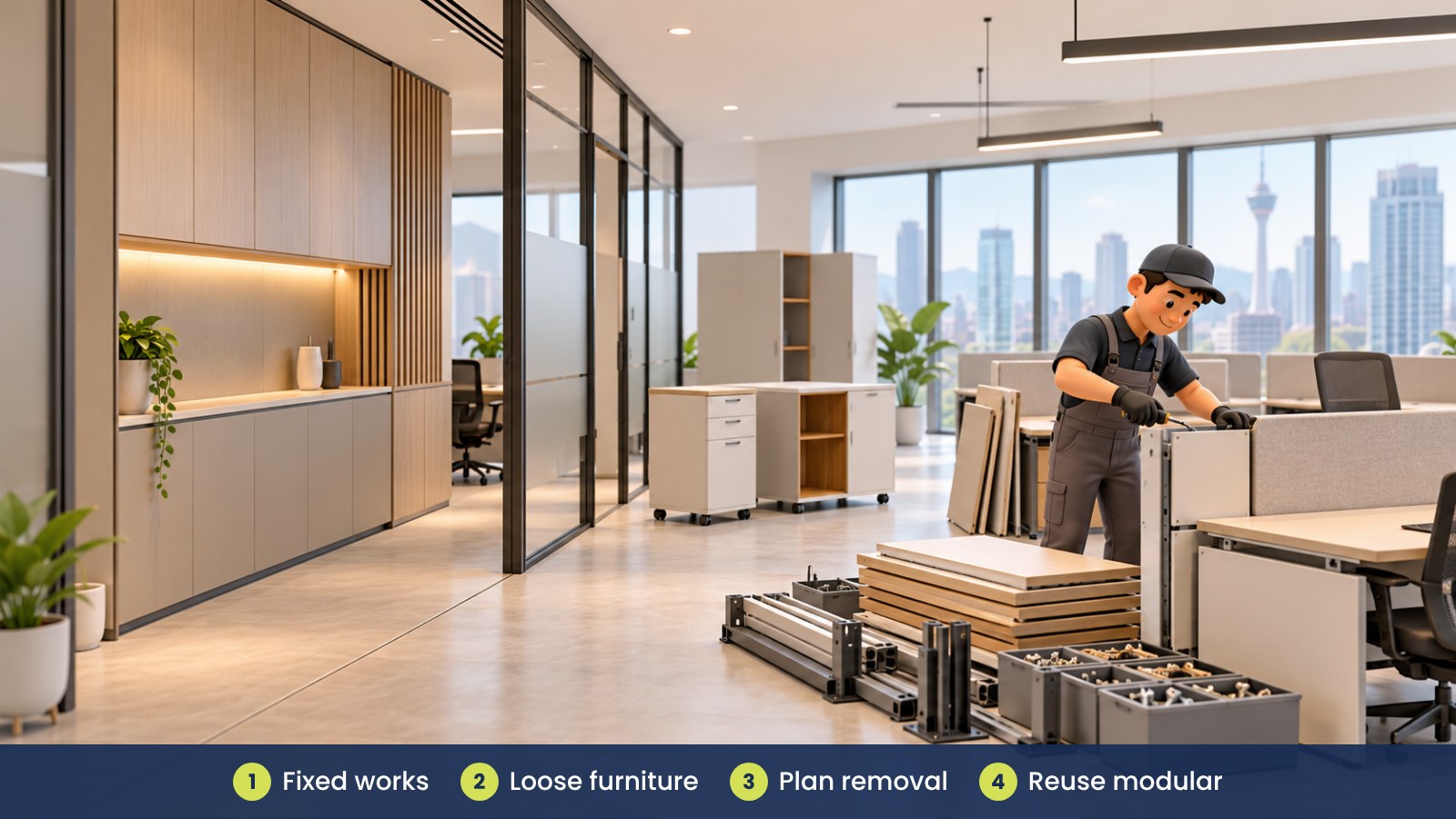
Start by separating fixed works from loose items. Fixed works are changes attached to or integrated with the unit, such as partitions or built-in cabinetry. Loose items include desks, chairs, storage units and other furniture that can usually be moved without changing the property itself.
This distinction is useful for planning, but the agreement and written approvals still matter. An item that appears removable may have been installed under specific conditions, so check rather than assume.
| Area or item |
What to compare |
Practical next step |
| Partitions and built-ins |
Original condition, approved drawings and written permissions |
Confirm whether removal or repair is expected |
| Ceiling, flooring or services |
Handover records and any changes made during the tenancy |
Ask how changes should be treated before booking work |
| Loose furniture |
Ownership, condition and whether it belongs to the tenant |
Plan to move, reuse or remove it |
| Damage or repairs |
Existing records, current condition and agreement terms |
Photograph and discuss disputed items early |
How should you check your tenancy agreement?
Look for wording about alterations, reinstatement, repairs, fixtures, approvals, inspection and handover. Also check any schedules, drawings, inventories or letters that were issued when you took the office or received permission to make changes.
Make a list of questions instead of relying on assumptions. For example, ask whether a specific partition, cable route, counter or built-in cabinet should remain or be removed.
Record the answer and who provided it. If there are several parties involved, confirm which contact is authorised to advise on the unit’s handover requirements.
For a project view that includes early planning, approvals and furniture decisions, see the office fit-out timeline from brief to handover.

Why can built-in items add to reinstatement work?
Built-in items can involve more steps because they are connected to walls, ceilings, floors or building services. Their removal may leave holes, marks or exposed areas that need attention, depending on the original condition and what the tenancy requires.
Loose or modular furniture is usually easier to move, dismantle and reuse elsewhere. It gives a tenant more flexibility if the team changes or the office lease ends, while fixed works can still be planned as part of a renovation where they suit the space.
Neither choice is automatically right for every project. Consider how long you expect to use the office, how the team may change and what the agreement says about alterations.
How should you prepare for the handover inspection?
Before the inspection, gather the tenancy agreement, original condition records, approved alteration documents and any agreed reinstatement notes. Walk through the office and photograph the current condition, including areas where work has been completed.
Use a simple checklist to track the status of each item. If the landlord or building representative identifies additional work, record what was discussed and confirm the next steps.
| Handover check |
What to record |
| Fixed changes |
Item, agreed treatment and supporting approval or instruction |
| Repairs |
Location, condition, photo and person responsible for follow-up |
| Loose furniture |
Items removed, retained or transferred to another location |
| Keys and access items |
What was returned and to whom |
| Outstanding matters |
Agreed action, owner and follow-up contact |
What are common reinstatement mistakes?
- Assuming a verbal comment replaces the written tenancy terms.
- Starting removal work before confirming what should remain.
- Failing to keep the original handover condition report or photographs.
- Mixing up tenant-owned loose furniture with fixtures or landlord-provided items.
- Leaving inspection questions until close to the move-out date.
- Not recording agreed changes or completed repairs.
What could this look like for a Malaysian tenant?
Fictional example: A company plans to leave a rented office with a built-in reception counter, several modular workstations and a meeting-room partition. The team checks its tenancy documents and finds that the partition was approved in writing, but the expected handover treatment is not clear.
Before booking removal, the tenant asks the property representative to confirm which items should stay and which should be removed. The team photographs the office, arranges the loose furniture for reuse and keeps a record of the agreed handover work.
What can go wrong?
If the reinstatement scope is unclear, work may be duplicated or items may be removed unnecessarily. Built-in furniture that does not suit the next office can also add dismantling and repair work, while loose furniture may be easier to take along. Checking the agreement and confirming expectations early helps you plan calmly.
How can iGreen help with furniture during a move?
iGreen Office Furniture can help with space planning, loose and modular office furniture, delivery and installation, and dismantling or relocating existing furniture. We can also help re-layout furniture when your team grows. Services are available in Kuala Lumpur and Penang.
Talk to iGreen Office Furniture about your office move or furniture plan.
Frequently asked questions
Does reinstatement mean removing everything from the office?
Not necessarily. The expected condition depends on your tenancy agreement, handover records and approvals for changes. Confirm what should stay or be removed.
Will my deposit be returned after reinstatement?
Deposit handling depends on the tenancy agreement and the condition and handover process. Check your own agreement and keep records of agreed work and the inspection.
Are built-in office items always required to be removed?
No single rule applies to every tenancy. Check the agreement and written approvals, then confirm expectations with the landlord or property representative.
Can loose furniture be reused at the next office?
Often it can, if it is in suitable condition and fits the new layout and access route. Measure before moving and plan dismantling where needed.
Prepared by iGreen Office Furniture