This article is general guidance, not legal advice.
You can often add desks to a growing team without renovating the whole office if you plan the layout, furniture and circulation together. Modular furniture, a phased setup and a review of existing storage can help you use the current space more effectively.
Key Takeaways
- Check how the team uses the office before adding more desks.
- Measure the space and review walkways, access and shared areas.
- Consider modular desks and storage that can be rearranged as needs change.
- Add furniture in stages where the layout and project plan allow it.
- Renovation may still be needed if the space, services or fixed layout cannot support the change.
The 2-minute version
- Count the need: confirm how many workpoints are needed and how often they will be used.
- Review the room: measure the available space and check how people move through it.
- Reuse first: identify furniture and storage that can stay, move or be reconfigured.
- Plan additions: choose desk sizes, locations and a practical installation sequence.
- Check the result: review the setup with the team and adjust where needed.
How do you know whether the office can take more desks?
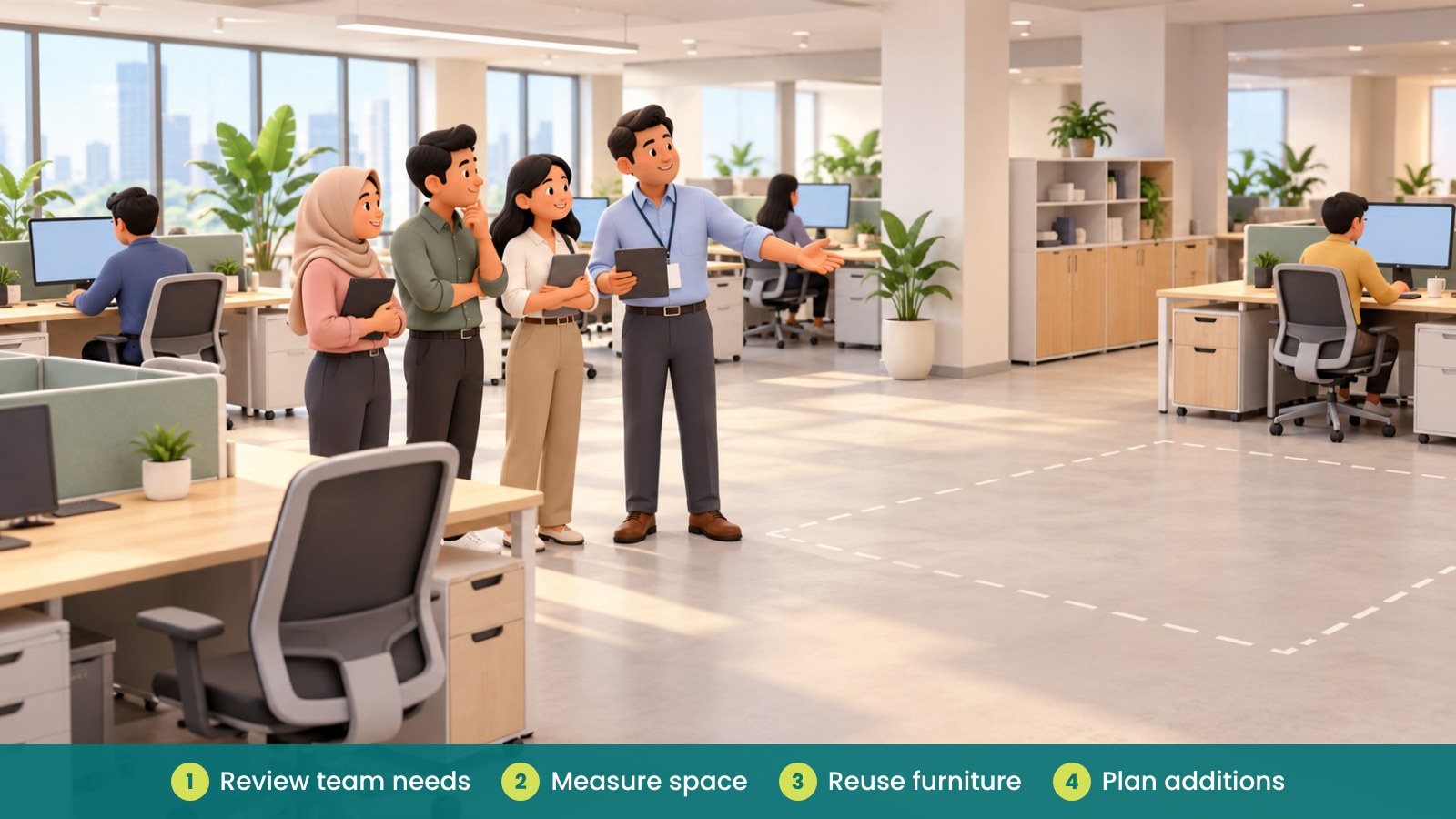
Start by checking how the current office is used. Look at which workstations are regularly occupied, where people meet and whether storage or furniture is taking up space that could be arranged more effectively.
Measure the rooms and record the furniture dimensions. Then sketch a proposed layout that includes desks, chairs, storage and shared areas. Leave space for people to move between workstations and reach doors, shared equipment and meeting areas.
If the team’s attendance changes across the week, consider whether all employees need a dedicated desk at the same time. Base the plan on your team’s real working pattern and any requirements the company has for assigned workspaces.
Which furniture can you reuse or rearrange?
Before buying new desks, check the condition and dimensions of the furniture you already have. Some workstations may be moved to another area, while cabinets could be repositioned to create a clearer layout.
Modular furniture can make future changes easier because compatible components can often be rearranged or extended. Confirm that the parts fit together and that any additions can work with the existing setup.
| Furniture or area |
What to check |
Possible action |
| Existing desks |
Condition, size, layout and access |
Keep, relocate or replace selected units |
| Workstation systems |
Whether components can be rearranged or extended |
Reconfigure or add compatible modules |
| Storage |
What is stored and how often it is used |
Reposition cabinets or plan shared storage |
| Meeting areas |
Actual use and availability at busy times |
Review the layout before using the area for desks |
How should you plan the new desk layout?
Place the additional desks where people can work without making the office feel crowded. Consider chair movement, access to storage, shared equipment and the route between work areas.
Think about the wider setup as well as the desk count. Employees may need suitable chairs, monitor positions, power access and a convenient place for personal or team storage. If you are changing several workstations, consider whether a consistent modular system would make later changes easier.
Check the layout with the people who use the space. A short review can reveal practical issues, such as a team needing nearby storage or a walkway becoming awkward when chairs are in use.
Can you add desks in phases?
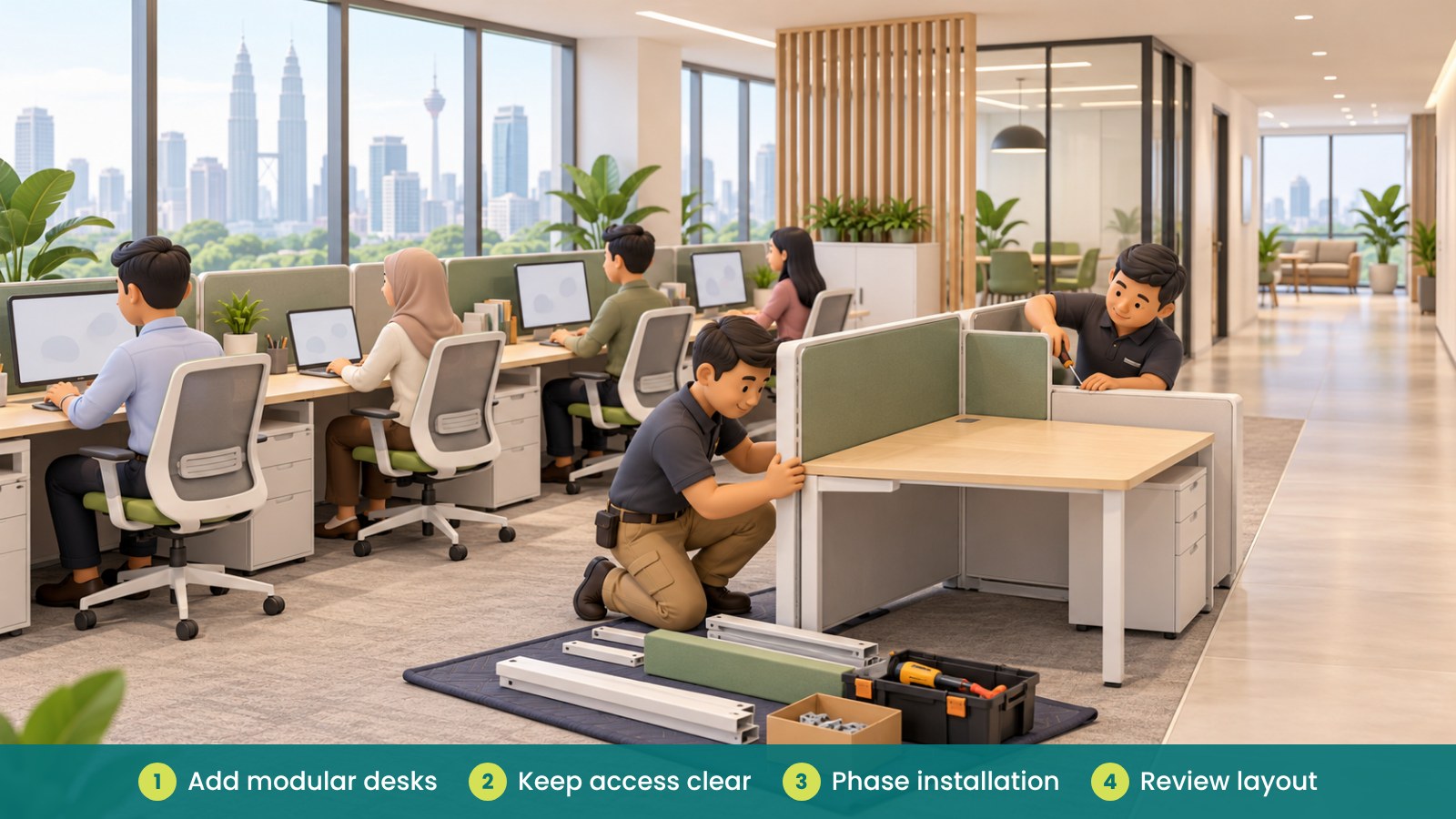
A phased addition may suit a team that is growing gradually or a project with several departments. The first stage could focus on the workpoints needed now, while the layout leaves room for compatible additions later.
Before dividing the work into stages, confirm that each stage will leave the office usable. Coordinate furniture delivery and installation with your building’s procedures and the team’s work schedule.
| Phase |
What to plan |
What to check afterwards |
| Review |
Current furniture, team needs and available space |
Confirm the proposed layout fits the room |
| First addition |
Priority desks, chairs and essential storage |
Check circulation and team feedback |
| Later additions |
Compatible furniture and reserved space |
Confirm the layout still works as the team grows |
When might renovation still be needed?
Furniture changes can help use space differently, but they cannot solve every space constraint. You may need to review the wider fit-out if the office does not have enough usable area, if fixed elements restrict the layout or if changes to services or building elements are being considered.
Coordinate any fixed works with the renovation team and building management. Treat walls, ceilings, flooring and mechanical and electrical services as part of the renovation plan, while considering desks and storage as loose or modular furniture where they may need to move.
For a stage-by-stage overview of coordinating layout, furniture and delivery, see the office fit-out timeline from brief to handover.
What are common mistakes when adding desks?
- Counting desks without checking how the team actually uses the office.
- Adding workstations before measuring furniture, rooms and access routes.
- Filling shared areas without considering how employees use them.
- Buying furniture that cannot work with the existing system or future additions.
- Forgetting storage, chair movement and circulation when planning capacity.
- Assuming furniture changes can solve every issue with a crowded layout.
What could this look like for a Malaysian SME?
Fictional example: A Kuala Lumpur company expects to add several employees but wants to keep its current office. The team reviews which desks are used regularly, measures the available area and identifies storage that can be moved.
It adds compatible modular workstations in one part of the office and checks how the layout works before planning any further additions. This gives the team a chance to adjust the arrangement using real feedback.
What can go wrong?
If desks are added without checking movement, storage and access, the office may feel crowded and harder to use. Furniture that does not fit the existing layout can also make future additions more complicated. If the space cannot support the change, the team may need to consider a wider layout or renovation plan.
How can iGreen help?
iGreen Office Furniture can help with space planning, loose and modular office furniture, delivery and installation, and dismantling or relocating existing furniture. We can also help re-layout the office as your team grows. Services are available in Kuala Lumpur and Penang.
Contact iGreen Office Furniture to plan your growing workspace.
Frequently asked questions
Can we add desks without renovating?
Often, yes, if the space and layout can support them. Measure the office, review circulation and check whether existing furniture can be rearranged before deciding.
Should we replace all our current desks?
Not necessarily. Check their condition, dimensions and compatibility with the planned layout. Some desks may be reused or moved to another area.
Is modular furniture useful for a growing team?
It can be useful when components can be rearranged or extended to suit later changes. Confirm compatibility and available space before selecting a system.
How can we avoid disrupting the team when adding desks?
Agree the installation sequence, coordinate access and schedule the work around how the office is used. Check the finished layout with the team.
Prepared by iGreen Office Furniture